When I finish writing the first draft of a script, there’s usually a problem.
I read it, and the characters seem flat. One-dimensional. Mere pawns of the plot that I forced them into.
You see, I tend to start with what I hope is a strong concept, and then move onto “breaking the story” (i.e. outlining it) with a high degree of “intention meets obstacle” for the main character(s).
But what I haven’t done is create people that are memorably real, interesting, surprising and complex.
In other words, dimensional characters.
You might also have this problem, maybe without knowing it. It took me a while to see it in myself.
Now that I know, I’m ready for it. And there are a few things that I do to try to address this.

First, though, what do I mean by dimensional characters? (a/k/a complex)
They’re not defined by only one basic thing. One goal. One drive. One personality quality.
They have more going on than just that.
Now there’s a place for “archetypal” characters who aren’t complex. The Dramatica software described the original Star Wars characters that way. They fulfill mythical hero’s journey functions (like “mentor,” “sidekick,” and “skeptic”) and in certain genres, that might be all you need.
I don’t typically write in those genres. And neither do most of the writers I work with. They tend to write dramas or comedies where dimensionality is often valued and necessary.
Even in action, thriller, mystery and horror scripts, it’s usually preferable that the people are dimensional. Even the villain. It tends to make things more interesting. More compelling. More real.
So how do you dimensionalize a character?
I have a few tricks I employ. The first is a way of thinking I read about once and have run with. (Sorry I’ve forgotten where I got this.)
It involves figuring out what a character’s main defining type or persona is — how they present to the world.
It’s always good to know this, by the way, and to make that clear as quickly as possible. If people knew this person how would they describe them? What’s the main takeaway? If they were in high school what clique would they be in? What activites would they do? How popular would they be? What’s their type? If you can find and illustrate that main quality early on, it helps with getting a clear handle on their personality.
But then… think about a contrasting quality one wouldn’t expect would go with that main one. And give them that, as well.
An example from a recent script of mine: I’ve got a woman who is a cutthroat businesswoman willing to do some questionable things to get what she wants. Her business? Yoga teacher.
You wouldn’t expect those two things to go together, right?
You don’t need many different dimensions. Just two like that which contrast and surprise can be enough. It takes the character out of the predictable and familiar.
I also look to get to know the character, to find other aspects of them that pin them down and make them ultra-specific. This adds a sense of dimensionality at the same time.
For instance, I’ll ask the following questions about each, coming up with answers that I’ll keep in mind as I rewrite:
1. What is their personality type, using Myers-Briggs and especially the Enneagram? (I talked about the latter in my post on character bios.)
2. Who have I known in my life who could be a good model for at least some key aspects of them?
3. What personality or emotional qualities of mine might they possess? (All characters tending to have some aspects of their creator. And they can be written better by really knowing those qualities.)
4. Who is the perfect actor that could embody this character and bring additional elements to it?
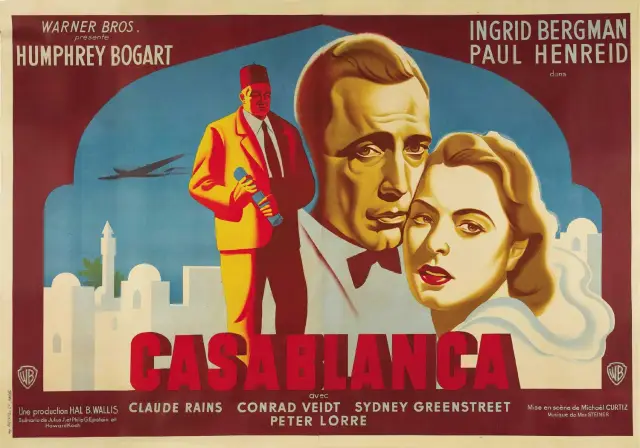
5. What is their “identity” they present to the world that is covering their true “essence” (to quote a Michael Hauge concept), which some past event has caused them to take on? (Like Rick losing Ilsa in Casablanca, turning a softie cynical.) This is often the source of their arc, and can be seen as their flaw.
All this goes into a “character pass” that I tend to do after my initial plot passes.
Some writers might work in the opposite way, all about character first and letting plot evolve from that. I tend to prioritize a “story that works” first with the characters (and also the themes) getting richer over time.
Either way, the goal is that the characters spring to life for readers as vividly engaging, real people. With telling and contradictory aspects and details that make them more than cliched or stock types.
Some of these might not be necessary to the plot. But they are part of doing the foundational pre-work of a script — where the writer ideally knows much more than what will be on the page.
Which inevitably makes the script stronger, more authentic, more believable, and more involving.

Like Chris, I too start with the story or plot first. Once I start to enlarge on the story, the characters generally fall into place, along with their main characteristics, peculiarities, even age, appearance and back stories etc. The story must have believable beginning, and progression to the end through plot points.
Good read. Diversity of personality, thought, imagination and viewpoint. And I just read a comedy book and the author breaks down many different characters types for ONSTAGE which can also be incorporated in to the mainstream characters in varying degrees 🙂
On a personal note, because my full name will not be public, I’ll share that I’m in the middle of having the absolute worst , toxic supervisor in the world. Usually assaults in life are more layered and subtle. But…. She is petty, gossipy and her communication style is shockingly emotional and attacking – the worst of the worst. I see and know her energy, and it’s a tough one to deal with – and she lies! – because I don’t know if others know how she is ie: they’ve been ignoring it for years and tolerate it, or what. It takes hours to decompress from her. I will not tolerate her for much longer. BECAUSE I’ve never met anyone like her, at times like this moment, I know I will use her unbalanced & psycho tendencies in a future character. But I have to survive this first.
Reassuring to hear you start with plot first, and let the characters develop over time – which is the same way that I work. I feel like most people come up with characters first and let that direct the plot, but I find I get too off track when I do that.